

Northstar · Healthcare
A hospital agent operations centre coordinating capacity, patient flow and clinical escalation, and showing what each agent's autonomy was worth.
com.northstar
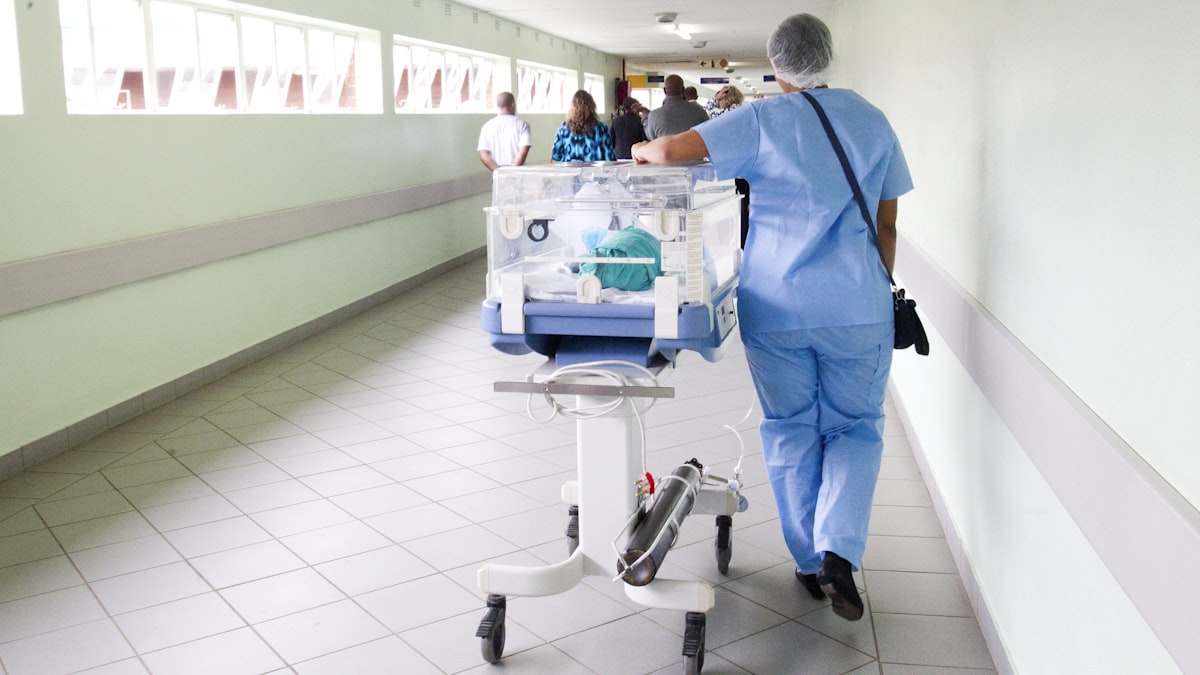
A hospital command centre where specialised agents watch admissions, capacity, clinical signals and support functions at once. Each reacts to hospital events, exchanges peer signals with the others, and hands decisions needing a human to an approval queue, with a command agent coordinating across all of them. Alongside the operational picture the demo keeps score of itself: what each agent contributed, what its autonomy avoided, and what every decision cost.
Agent roster
All 10 agents in this demo.
What this demo shows
The moments worth walking a prospect through.
Capacity and flow as one conversation
Capacity and flow are watched by separate agents that signal each other, so a bed freeing on one ward and a patient boarding on another are the same conversation rather than two dashboards, with boarding, acuity and awaiting-discharge tracked as live capacity risks.
Emergency department surge
A dedicated surge agent tracks arrival pressure and escalates when the department crosses its thresholds, routing the response through the same approval path as every other agent.
Early deterioration and infection signals
Clinical-signal agents surface patients trending the wrong way and infection-control risks as they emerge, as coordination prompts for staff, never as clinical judgements.
Support functions in the same picture
Operating room scheduling, pharmacy and equipment availability run as peer agents, so a theatre delay caused by missing equipment is visible as one chain rather than three unrelated alerts.
Staffing, rosters and agency cover
The staffing agent reasons over the roster and the cost of covering a gap, so a shortfall arrives with the options and their prices attached rather than as an alert someone else has to price.
Autonomy value, measured
The demo reports what each agent's autonomy was worth against a baseline (cost avoided, cost incurred, and contribution by agent), so the question 'what did the agents actually do for us' has an answer on screen.
Alternatives considered, not just the recommendation
Agent recommendations carry the alternatives weighed and the confidence behind them, so a clinician reviewing an approval sees the reasoning rather than a single output to accept or reject.
Full audit and decision history
Every recommendation, approval and action lands in a complete decision history, so any state the hospital reached can be walked backwards to the events and approvals that produced it.
Demo gallery
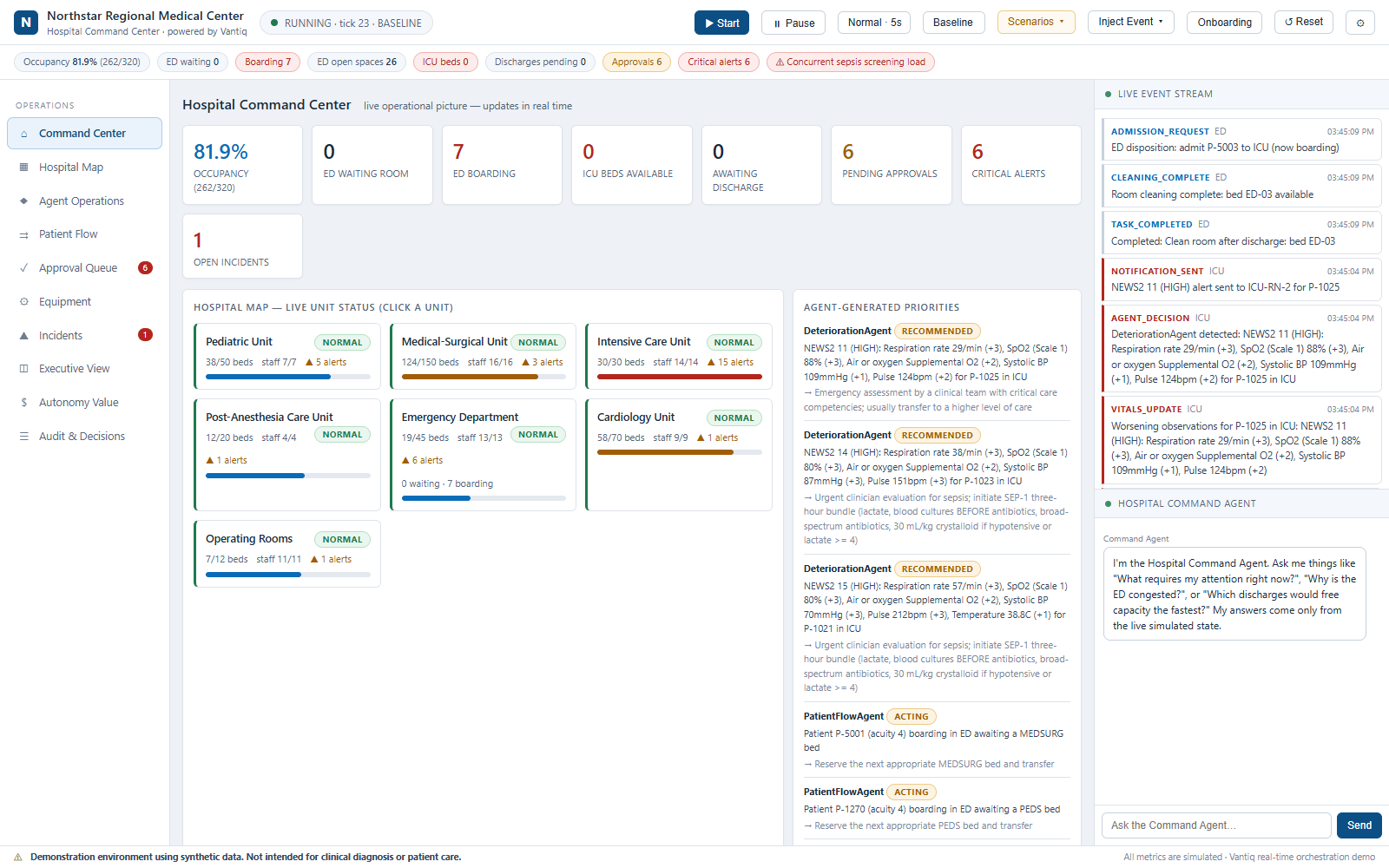 Command Center: occupancy, ED waiting and boarding, ICU beds and pending approvals over a live unit map, with the event stream running beside it.
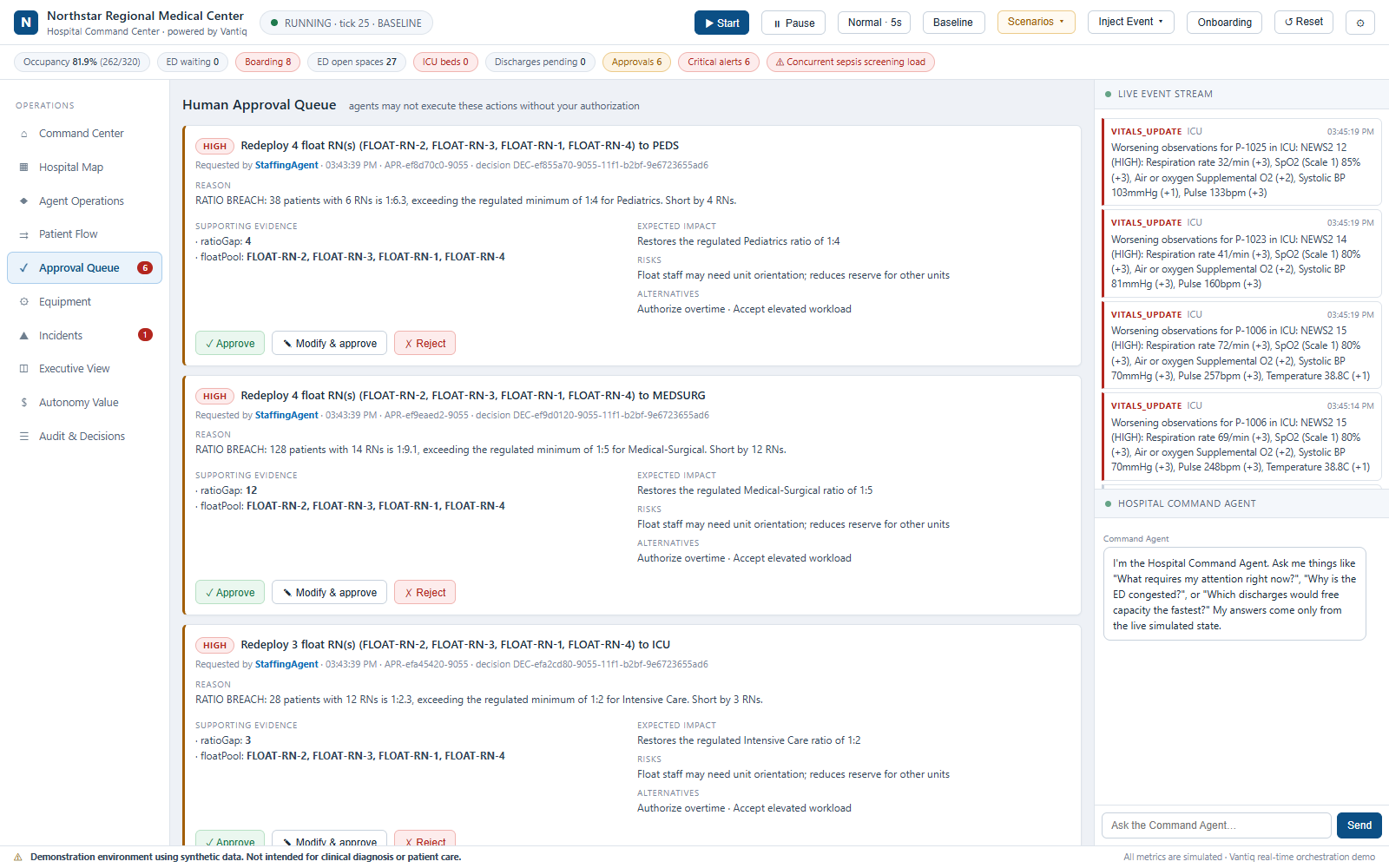 Human Approval Queue: agents may not execute these actions without authorization. Each request carries the reasoning, the supporting evidence, the expected impact, the risks and the alternatives considered.
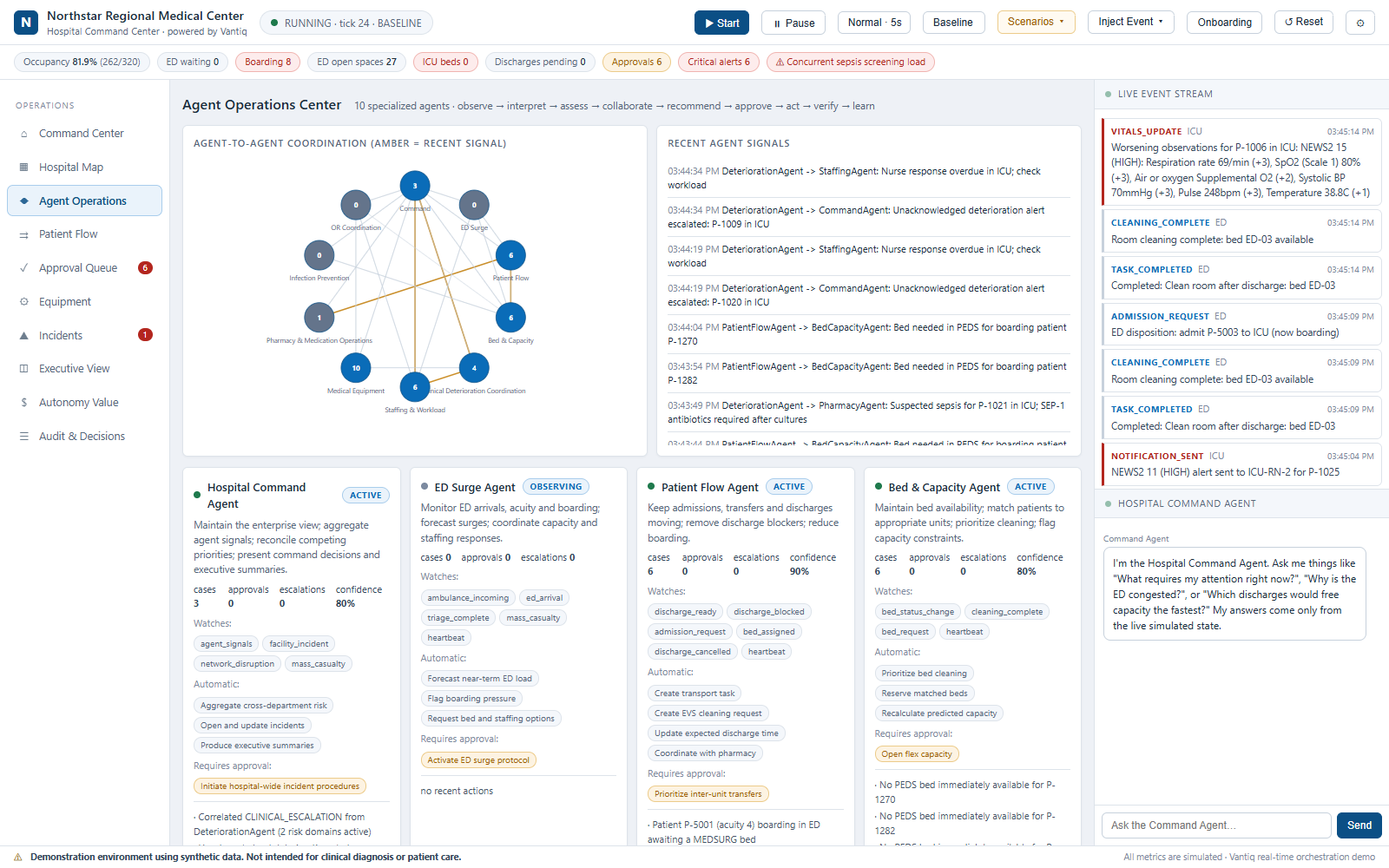 Agent Operations: the peer-signalling mesh between the specialist agents, with each agent's card and the case it is currently working.
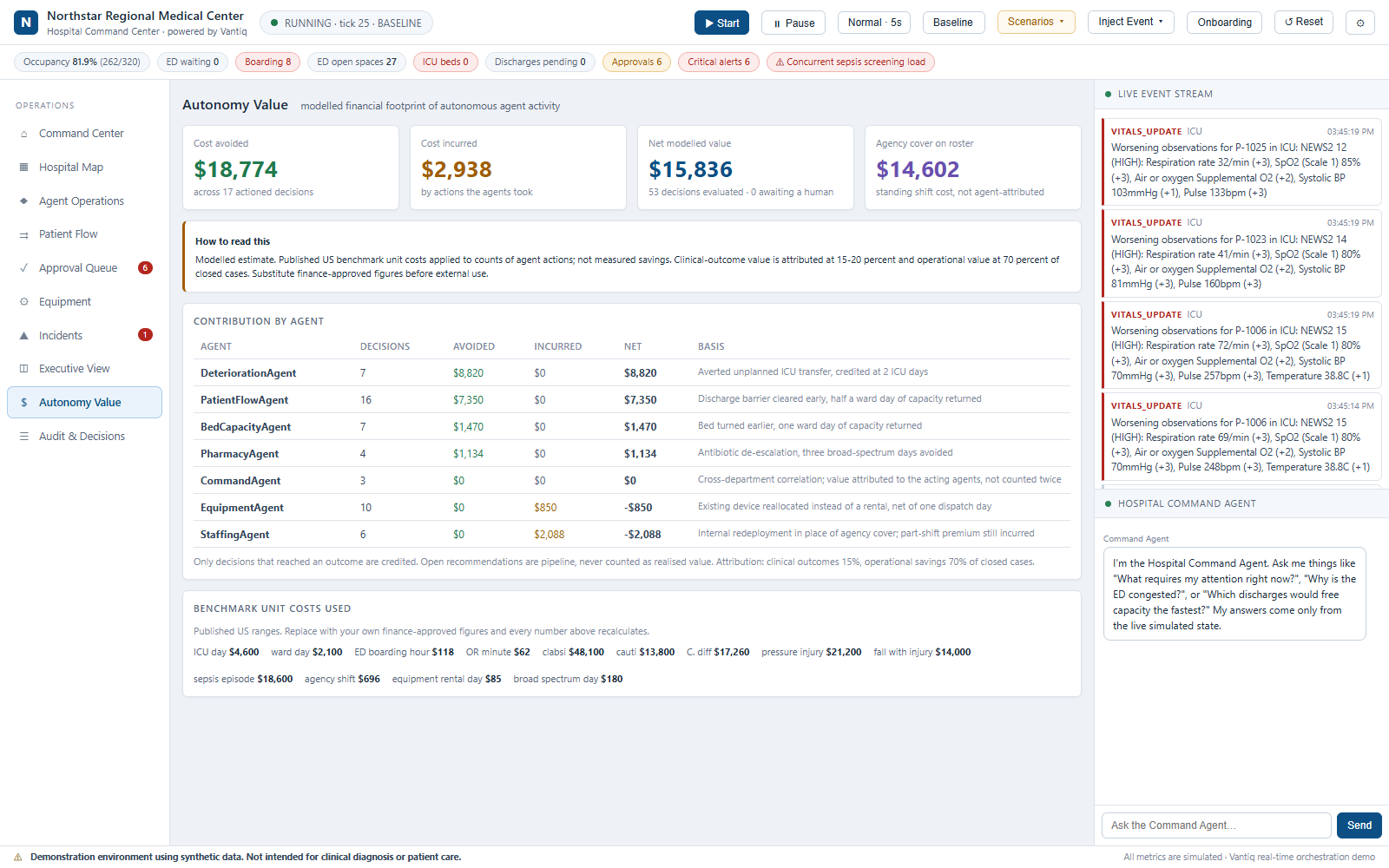 Autonomy Value: what each agent's autonomy was worth against a baseline: cost avoided, cost incurred, and contribution by agent.
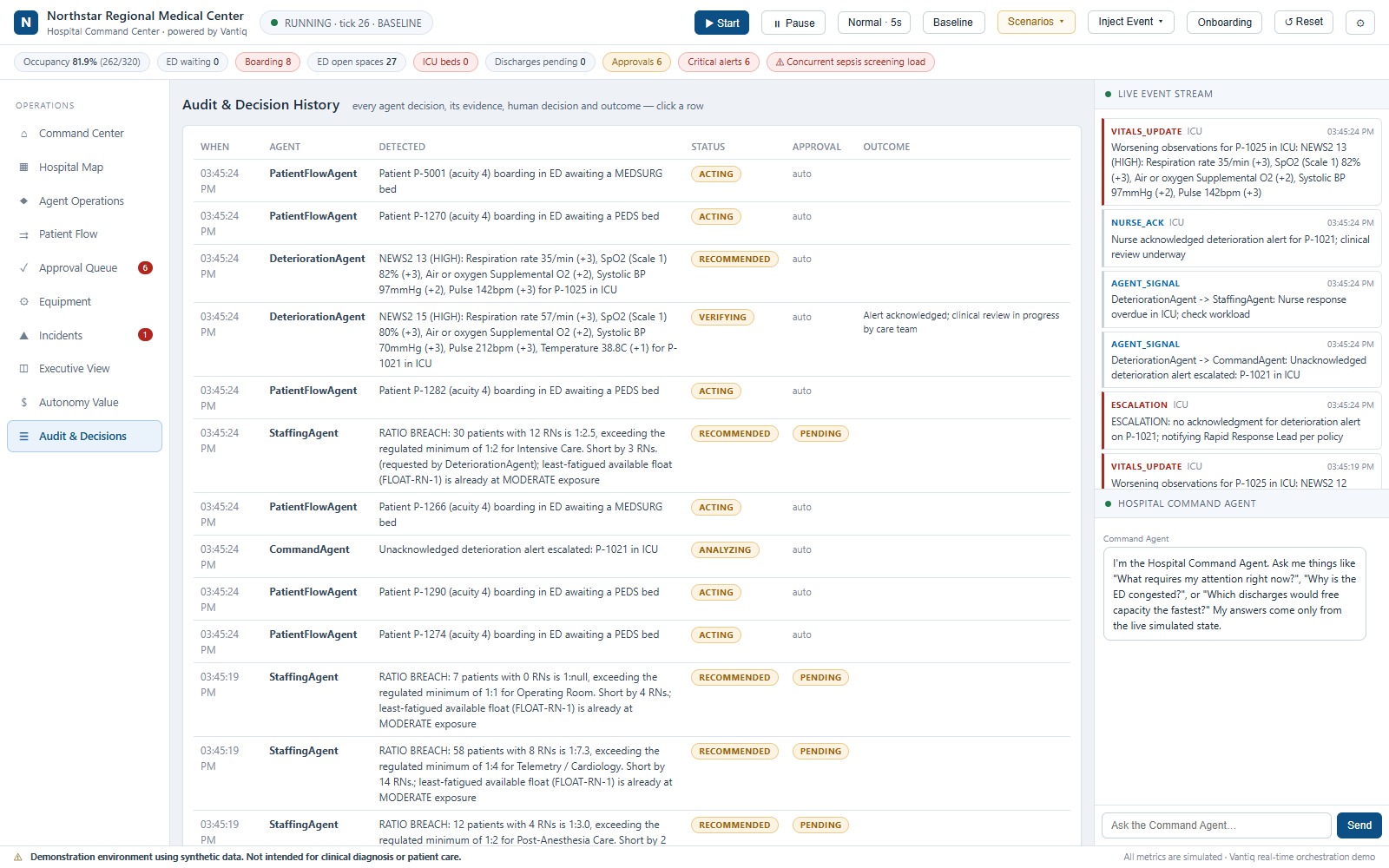 Audit and Decisions: every recommendation, approval and action, so any state the hospital reached can be walked back to what produced it.
Want to walk a customer through this?
Demo environments are provisioned per partner. Request access and the team will set up a namespace you can run this in front of a prospect.
Request demo access
[email protected]