

Sentinel · Defense
Multi-domain situational awareness where deterministic agents fuse observations across domains and route every consequential decision to human authority.
com.sentinel

A synthetic multi-domain command-and-control demonstration. Deterministic agents monitor a six-site operating area, fuse observations across domains, and route consequential decisions to human authority, expressed in the doctrinal vocabulary a military audience already reads: CCIR/PIR/FFIR, NATO Admiralty grading, ATP 5-19 risk, DRRS readiness, Days of Supply, PACE, MEDEVAC 9-line and Sphere minimum standards. All data is synthetic. The platform models no weapons, no targeting and no lethal effects, and never applies a posture change on its own authority. There is no LLM anywhere in it: every agent is deterministic, so behaviour is reproducible and auditable.
Agent roster
All 12 agents in this demo.
What this demo shows
The moments worth walking a prospect through.
Findings answer the questions the commander asked
Assessments are matched against standing information requirements (PIR, FFIR, CCIR and EEFI), and a tripped commander-level requirement raises the authority needed, even where the agent had assessed the action as something it could take alone.
Uncertainty is preserved, not resolved away
Corroboration and contradiction drive a NATO Admiralty grade. Contradictory reporting produces an incident held as uncertain rather than an adjudicated answer, and data carrying spoofing indicators is quarantined for review instead of mutating the operational picture.
Authority is verified, not asserted
A 'deciding as' selector runs every approval against who actually holds authority, at what level, over what scope, and whether it has been revoked. An agent cannot approve its own request, and delegation only ever moves downward.
The refusals are the demonstration
A refused decision writes an authority-violation record naming the control and the reason, and the request stays pending. A control that refuses silently is indistinguishable from one that isn't running.
A cross-domain guard that renders verdicts
Caveats are evaluated before classification level, because a handling restriction is absolute rather than a threshold. One record passes at an own-force boundary and is blocked at a coalition boundary accredited to the same level, and redaction copies rather than deletes, so the partner receives less while the command picture keeps everything.
Classification by compilation
An aggregate is classified no lower than the most sensitive report in it and inherits every contributing caveat. Correlating a second domain into an open incident can reclassify it upward by the act of correlation, not by anyone deciding to reclassify.
Edge autonomy through a disconnection
When a site loses its link, events queue locally and the platform keeps operating on its own authority within set bounds. Reconnection surfaces a sync conflict that is flagged rather than silently overwritten.
A tamper-evident audit chain
Every audit record is sealed into a hash chain, so whether the trail has been altered stops being a matter of trust and becomes a computation. The demo can break its own chain live, name the damaged record, and restore it.
An accreditation worksheet that re-runs
A verification suite turns each safety and security claim into an assertion that can fail, and a control matrix maps NIST 800-53 controls to the resources implementing them and the tests proving them, recomputed on every run.
Command products built from recorded evidence
Commander's Update Briefs and After-Action Reviews are generated from what actually happened in the run, so every sustain finding traces to a recorded event rather than a narrative written in advance.
Demo gallery
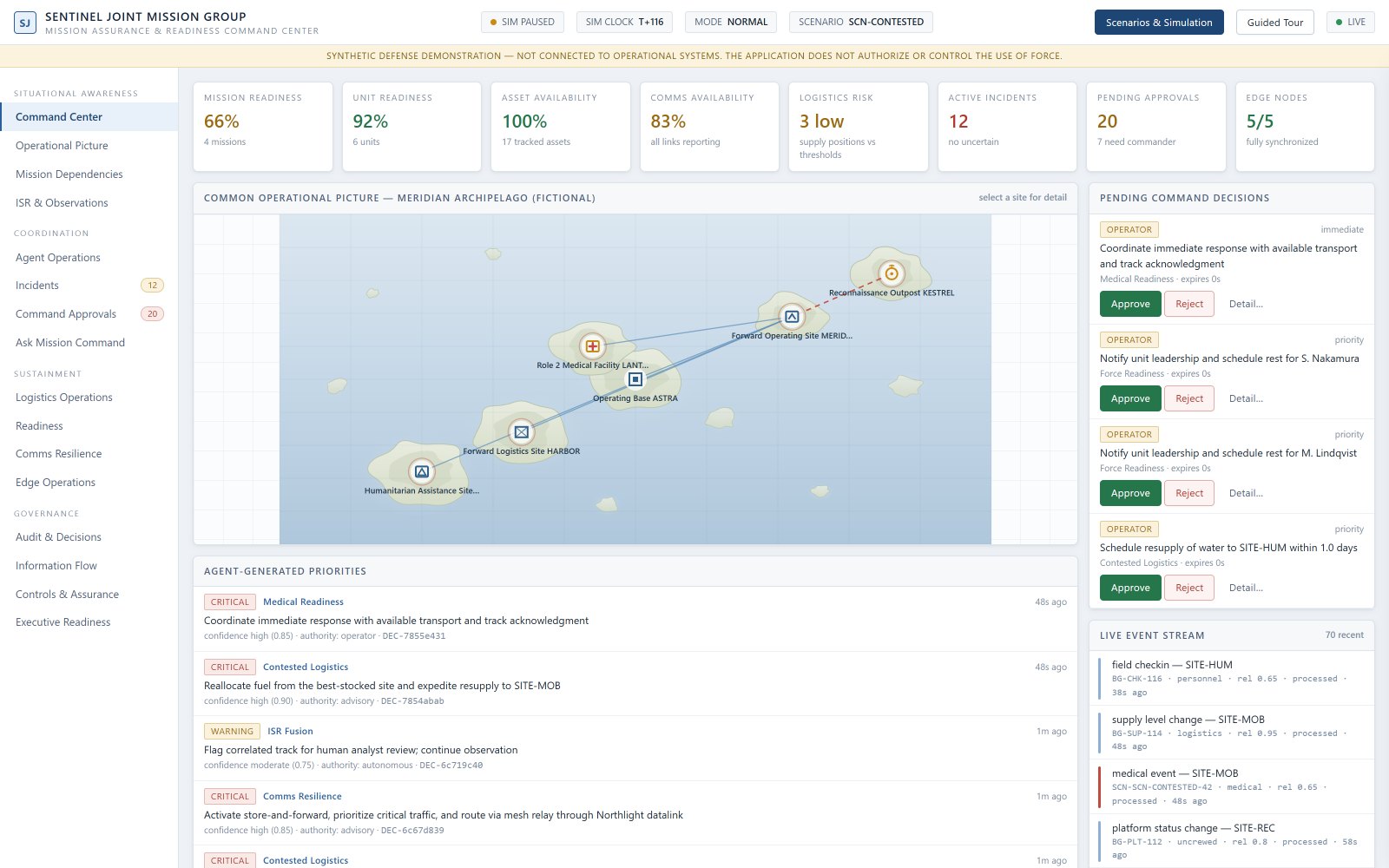 Command Center: mission readiness, open incidents and pending approvals over the common operational picture, with the event stream alongside.
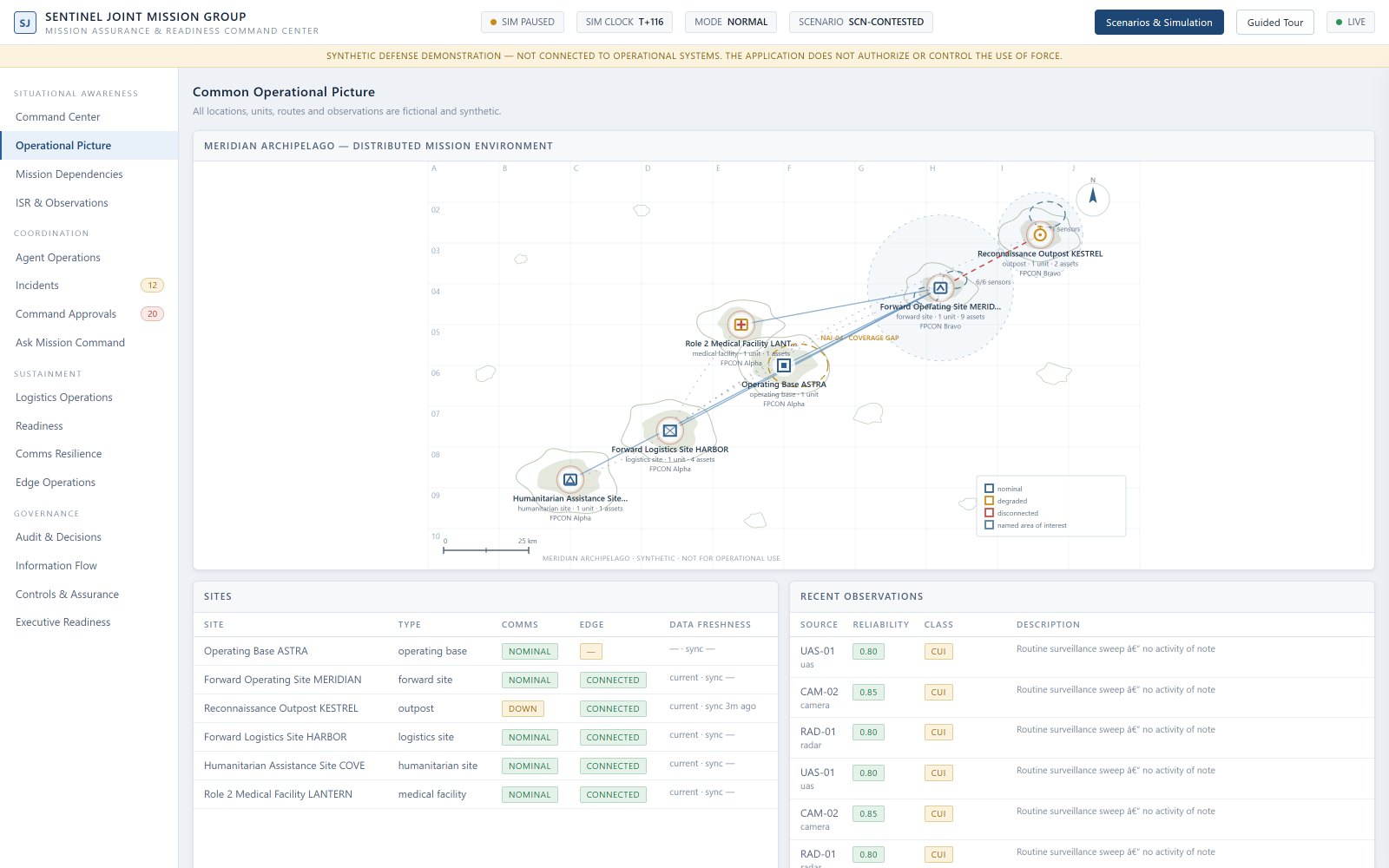 Common Operational Picture: six sites with comms links, sensor coverage rings and named areas of interest. Only friendly and neutral symbology is drawn; there are no target areas.
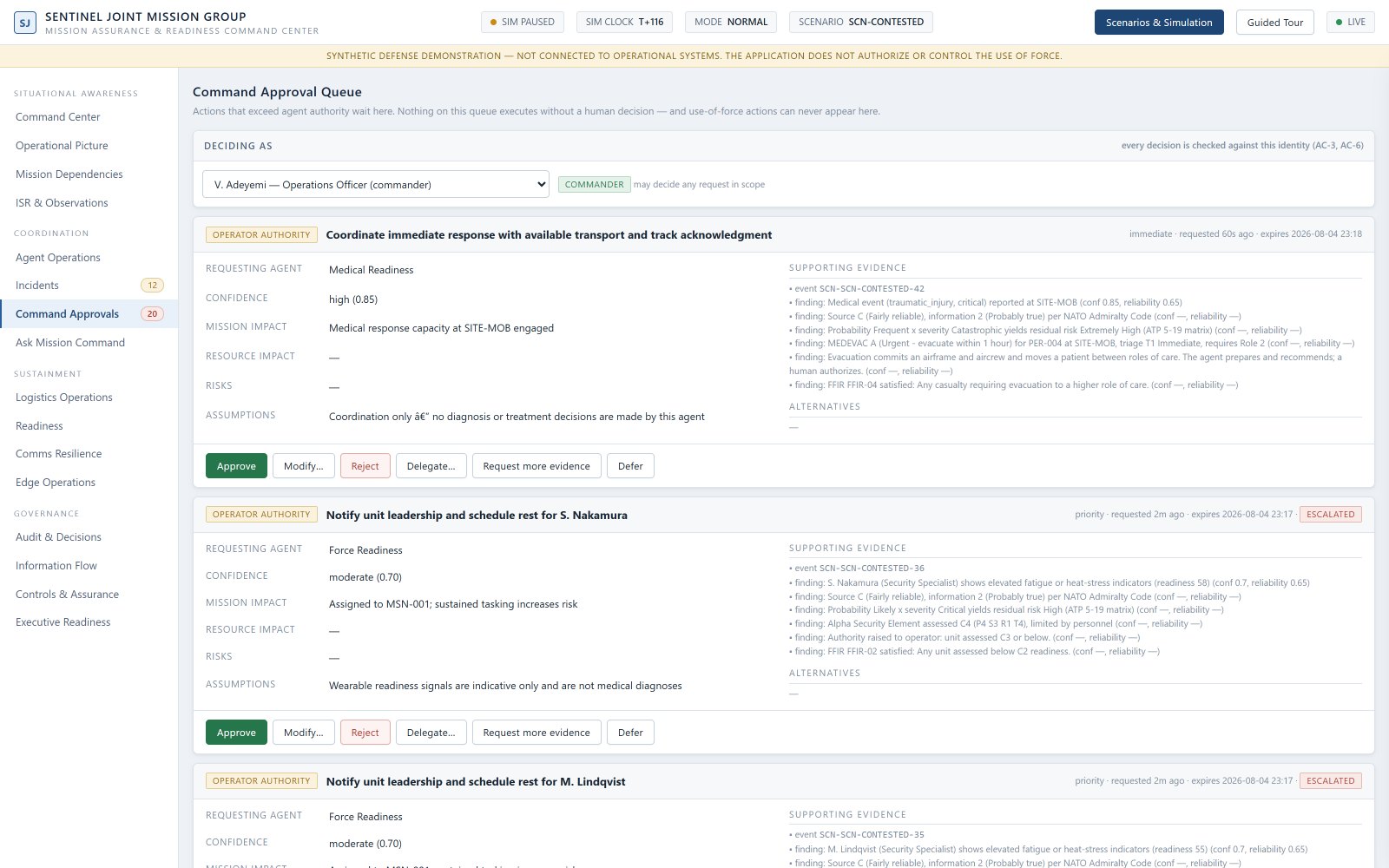 Command Approval Queue: decisions routed to human authority, each carrying its evidence, Admiralty source grading and residual risk. The 'deciding as' selector checks the decision against who actually holds authority.
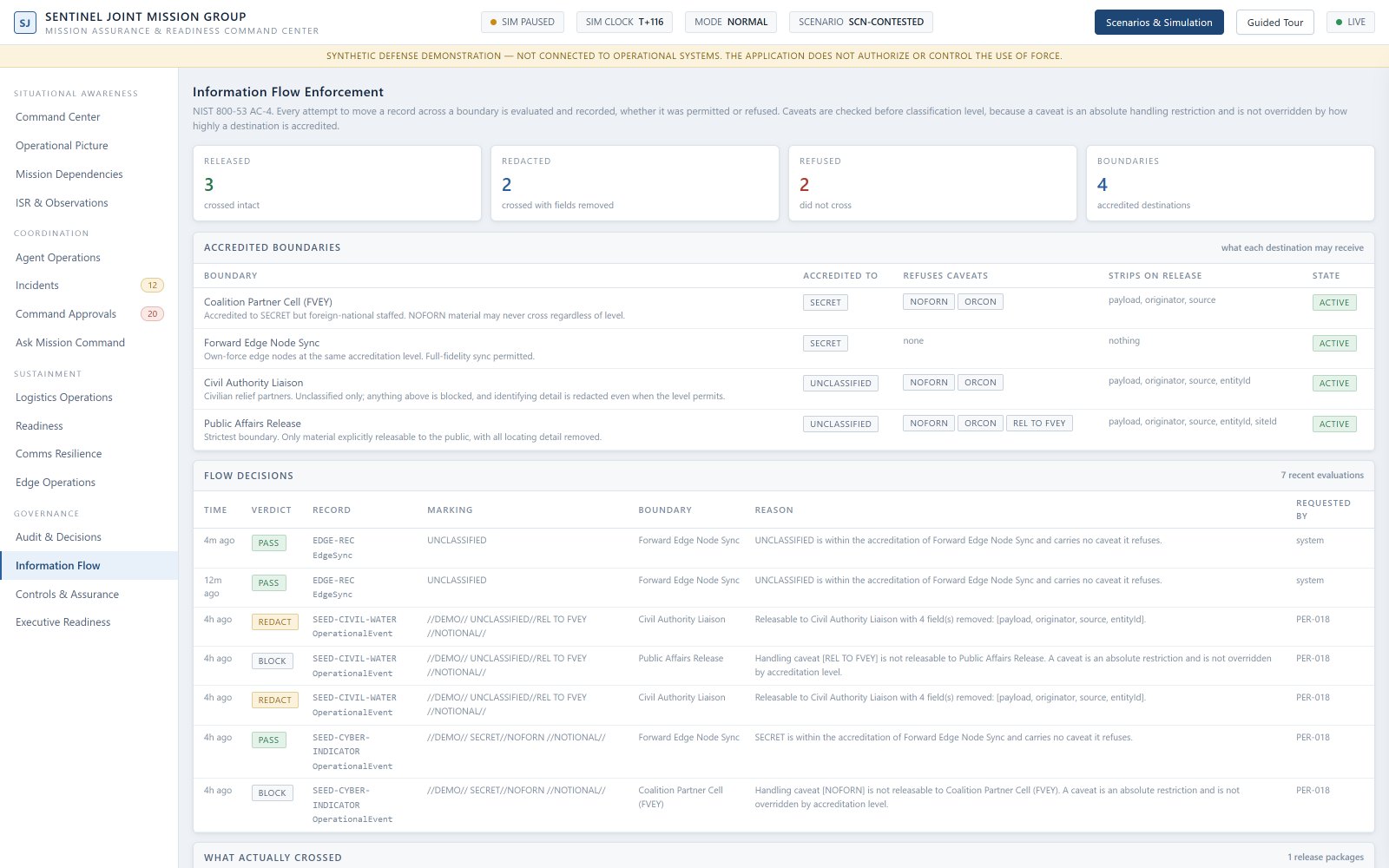 Information Flow Enforcement: accredited boundaries and every verdict the cross-domain guard rendered, permitted and refused alike, each with its reason.
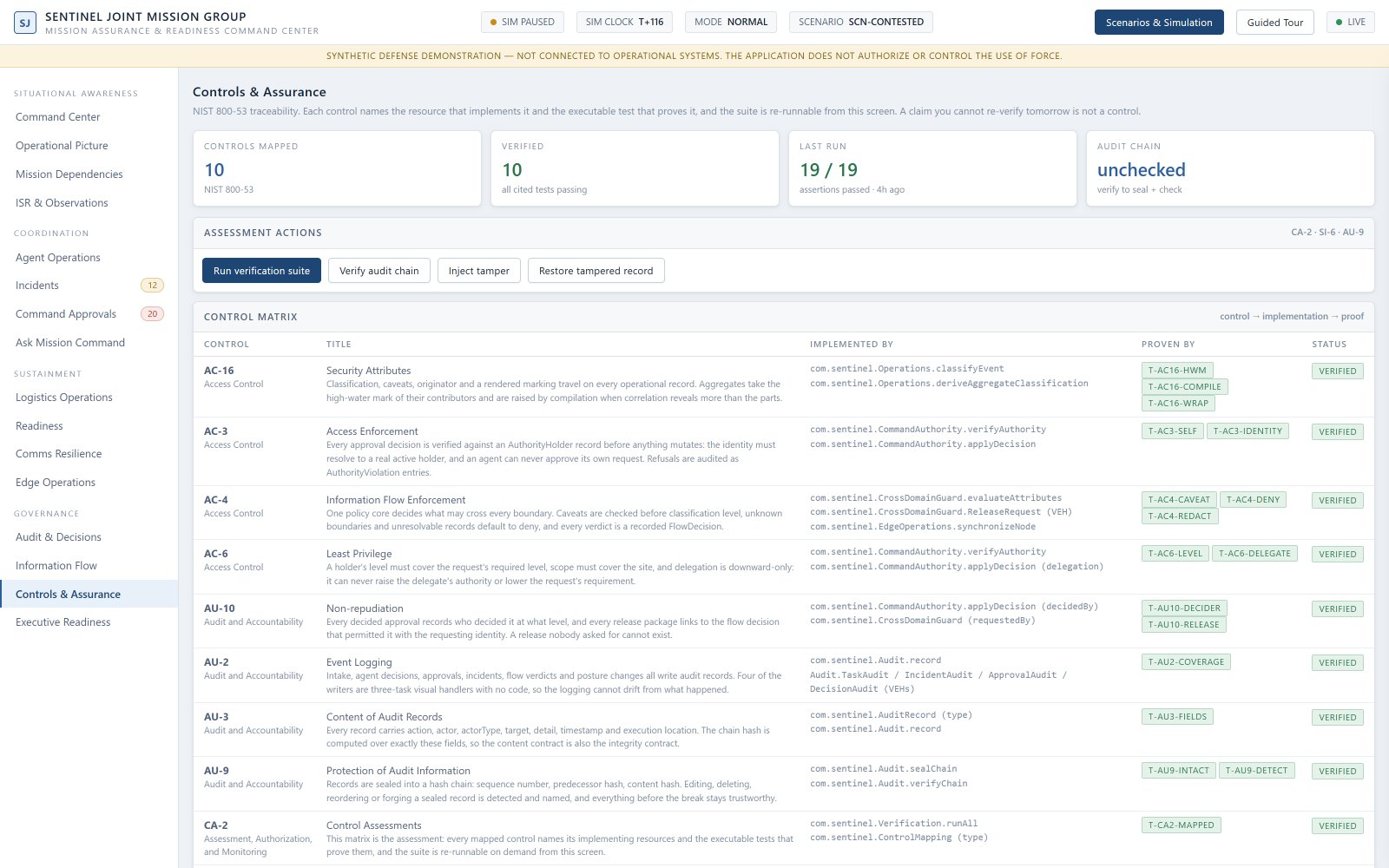 Controls & Assurance: NIST 800-53 controls mapped to the resources implementing them and the tests proving them, recomputed on every run.
Want to walk a customer through this?
Demo environments are provisioned per partner. Request access and the team will set up a namespace you can run this in front of a prospect.
Request demo access
[email protected]